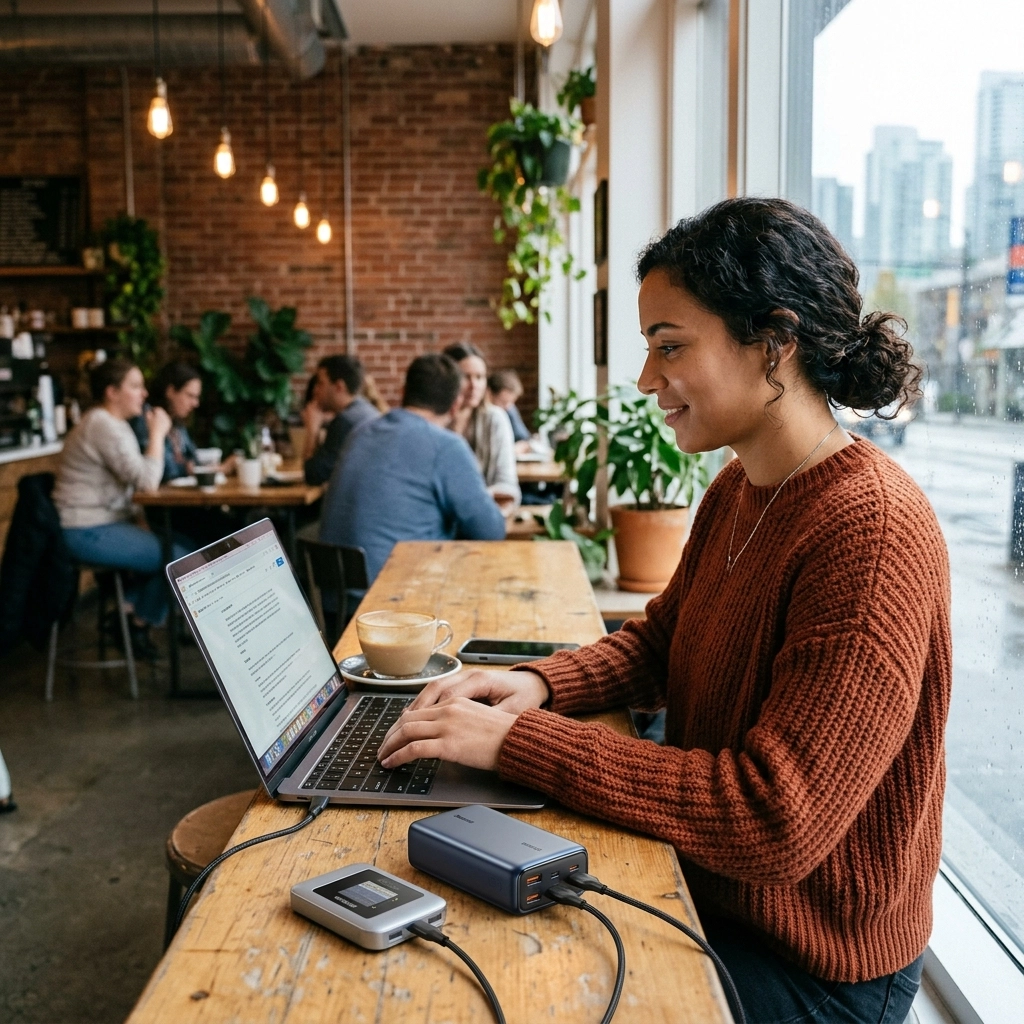
Photo by Alexandru Acea on Unsplash
If you’ve been following the journey here at Digital Nomad Lad, you know I’m all about keeping things lean, efficient, and, most importantly, real. It’s April 2026, and the world of remote work has changed. We aren't just hunting for any Wi-Fi anymore; we’re looking for high-speed 5G, seamless connectivity, and gear that doesn’t break our backs (or our bank accounts) while we move between Portugal and Thailand.
I’ve spent the last few months testing the latest "must-have" kits to see what actually survives a month in a backpack and what ends up at the bottom of the bag, gathering dust and regret. Whether you’re just starting out with our Digital Nomad Lad Guide or you’re a seasoned pro, your tech stack is your lifeline.
Let’s get into the gear that earned its spot in my bag this year, and the stuff you should definitely leave at home.
5 Gadgets Worth Every Gram in Your Bag
When you’re hopping between a co-working space in Soho, London and a beach cafe in Bali, your gear needs to be versatile. Here are the five items that I simply won't travel without in 2026.
1. The 13-inch Ultrabook (The "M" Series or High-End Carbon)
Your laptop is your office, your cinema, and your connection to the world. In 2026, the sweet spot for weight is exactly 3 lbs (1.36kg). Anything heavier feels like a brick after a mile-long walk to a cafe. I’m currently rocking a machine with an integrated AI chip that handles background noise suppression and video enhancement natively, perfect for those noisy street-side calls.
Why it’s essential: It’s the balance of power and portability. You need something that can handle 20+ Chrome tabs, a Zoom call, and maybe some light video editing without the fans sounding like a jet engine.
Score: 9.5/10. It’s the only item on this list that is truly non-negotiable. If this fails, the trip ends.
2. The 100W GaN Multi-Port Charger
Stop carrying four different "bricks" for your phone, laptop, headphones, and watch. Gallium Nitride (GaN) technology has peaked in 2026, giving us tiny chargers that pack massive power. One single plug with three USB-C ports and one USB-A port is all you need.
Why it’s essential: Most hotel rooms or Airbnbs have one conveniently placed outlet and four inconvenient ones. With a 100W GaN charger, you can fast-charge your laptop and your phone simultaneously from a single socket. It saves space, weight, and the headache of tangled cables.
Score: 10/10. This is arguably the most "quality of life" improvement you can make to your bag for under £60.
Photo by Alex Kotliarskyi on Unsplash

3. Global eSIM Apps (The End of the SIM Tool)
Remember carrying that tiny metal pin and worrying about losing your home SIM card? Those days are over. In 2026, I use apps like Airalo or Holafly exclusively. Before my plane even touches down in Toronto, I’ve already bought a 10GB local data plan and activated it.
Why it’s essential: Reliability and safety. You have 5G data the second you turn off airplane mode. This means you can call a Bolt or Uber immediately without hunting for "Free Airport Wi-Fi" that never actually works. With average 5G speeds in nomad hubs now hitting 200Mbps, you can even tether your laptop in a pinch.
Score: 9/10. It’s slightly more expensive than buying a local SIM in a shop, but the convenience of staying connected 24/7 is worth the extra few quid.
4. Noise-Canceling Over-Ear Headphones
Earbuds are great for the gym, but for deep work, you need the "big guns." Whether it's the roar of an airplane engine or the chatter of a busy cafe in Montreal, high-end noise cancellation is a productivity multiplier.
Why it’s essential: It creates a "focus bubble" anywhere. I prefer over-ear models because the battery life in 2026 is now pushing 60+ hours, meaning I only charge them once every two weeks. Plus, they act as a "do not disturb" sign to everyone else in the co-working space.
Score: 8.5/10. They are a bit bulky, but the mental health benefits of silence in a chaotic city are priceless.
5. 20,000mAh Power Bank (Airline Safe)
Don’t be the person sitting on the floor next to a bin because that’s where the only outlet is. A high-capacity power bank is your safety net. Make sure it stays under the 100Wh limit (usually 26,800mAh or less) so you don't get it confiscated at security.
Why it’s essential: It’s not just for your phone. A 20,000mAh bank with "Power Delivery" (PD) can actually give your laptop an extra 4-5 hours of life. If you’re working from a remote beach in Barcelona where power isn't guaranteed, this is your best friend.
Score: 9/10. It’s heavy, yes, but it’s the ultimate insurance policy against a dead battery during a deadline.
Photo by Campaign Creators on Unsplash

3 Gadgets That Are an Absolute Waste of Space
We’ve all fallen for the "cool" tech ads, but let’s be honest: your bag has limited real estate. If you’re looking to lighten the load, these are the first things I’d tell you to ditch.
1. The "Laptop-Replacement" Tablet
I see so many nomads carrying both a MacBook and an iPad with a Magic Keyboard. Unless you are a professional digital illustrator, the tablet almost always ends up being a very expensive Netflix machine.
The Reality: Trying to do "real" work like coding, heavy spreadsheet management, or freelance writing on a tablet OS is frustrating. It doesn't save weight because by the time you add the keyboard case, it weighs as much as an Ultrabook anyway. Just use your laptop for work and your phone for media.
2. Dedicated E-Readers
I love reading, but in 2026, having a dedicated device just for books is a luxury most nomads don't need. Modern phone screens are incredible, and with "Reading Mode" or "Eye Comfort" settings, the strain is minimal for short bursts.
The Reality: It’s another thing to charge, another thing to lose, and another thing to take out at airport security. If you're a hardcore bookworm, fair play, but for most of us, the Kindle just sits at the bottom of the bag while we scroll Reddit on our phones instead.
3. Portable Monitors (For Casual Workers)
If you are a day trader or a high-end video editor, okay, you might need the extra screen real estate. But for the average digital nomad job, a portable monitor is a massive weight penalty.
The Reality: They are fragile, require extra cables, and take up a huge amount of desk space. Most "cafe-style" tables in places like Chiang Mai aren't even big enough to fit a laptop and a second monitor. Learn to use "Spaces" or "Virtual Desktops" on your laptop instead: it’s free and weighs zero grams.
How to Build Your Own 2026 Stack
Building the perfect tech stack isn't about buying the most expensive gear; it’s about buying the right gear for your specific workflow. If you're just starting your journey, don't rush out and buy everything at once. Start with the basics: a solid laptop and a great charger: and see what you actually miss after a month on the road.
Check out our Gadgets & Tech category for deeper dives into specific brands we trust. We’re constantly updating our recommendations as new tech drops.
Quick Tip: Always carry one "emergency" physical USB-C to USB-A adapter. You never know when you’ll encounter a 2015-era printer or a weird charging port in an older Airbnb!
What’s the one gadget you can’t live without? Or did I just call your favorite piece of tech a "waste of space"? Drop a comment or reach out: I’d love to hear what’s working for you in 2026. Stay mobile, stay connected, and I’ll see you at the next co-working spot!
For more tips on living the nomad life, head back to the Digital Nomad Lad home page.